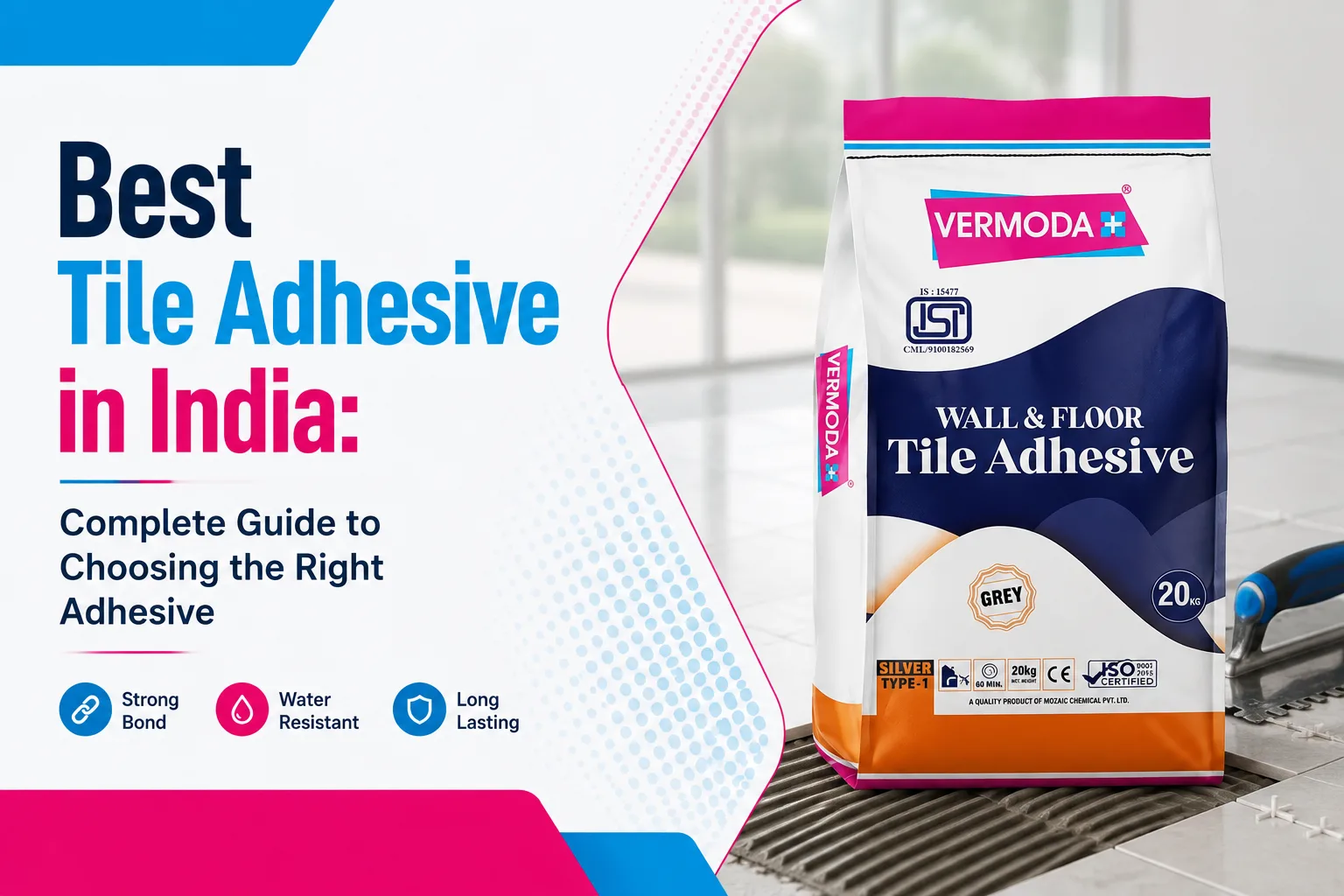
The best tile adhesive is the one matched to the tile, substrate, tile size, and installation environment. For modern construction, polymer-modified cementitious adhesives offer controlled bonding and application performance. The right choice depends on whether you’re fixing ceramic, vitrified, porcelain, marble, or large-format tiles, and whether the installation is indoors, outdoors, or in a wet area.
Table of Contents
ToggleWhat is tile adhesive and why is it used?
Tile adhesive is a formulated bonding material used to fix tiles to substrates such as concrete, cement plaster, screed, cement boards, and other compatible surfaces. Cementitious formulations commonly combine cement, graded mineral fillers, polymers, and chemical additives that control properties such as water retention, workability, open time, slip, and adhesion.
The main advantage over a basic sand-cement mixture is formulation control. Dense tiles such as vitrified and porcelain tiles have low water absorption, so relying on traditional mortar can make achieving a consistent bond more difficult. A purpose-designed adhesive is formulated for tile fixing and can provide more predictable application performance.
India’s BIS standard IS 15477:2019 covers adhesives for ceramic, mosaic, and stone tiles. The standard includes testing for properties such as tensile adhesion strength, shear adhesion strength, open time, adjustment time, slip, and deformability where applicable.
That gives buyers a useful lesson: don’t judge the best tile adhesive by the product name alone. Look at its intended application and technical performance.
How do you choose the best tile adhesive?
Start with four questions: What tile are you fixing? What is its size? Where will it be installed? What is the substrate?
1. Check the tile type
Ceramic, vitrified, porcelain, marble, and natural stone tiles don’t necessarily have identical adhesive requirements.
For example, low-absorption vitrified and porcelain tiles need an adhesive designed to provide suitable adhesion to dense tile surfaces.
2. Check the tile size
Tile dimensions affect adhesive selection and installation technique.
A small ceramic wall tile is a different installation problem from a large-format porcelain slab. Larger tiles may require a higher-performance adhesive and careful attention to adhesive coverage.
3. Check the substrate
Common substrates include:
- Concrete
- Cement plaster
- Cement screed
- Cement boards
- Existing tiles
- Other manufacturer-approved surfaces
The surface should be sound, clean, and appropriately prepared before adhesive application.
4. Consider the location
A dry bedroom floor and an outdoor façade face different conditions.
For bathrooms, balconies, terraces, swimming pools, exterior walls, and other moisture-exposed areas, select a product whose technical documentation specifically supports the application.
5. Consider movement and exposure
Temperature changes, moisture, substrate movement, and traffic can affect a tile installation.
Where movement or demanding exposure is expected, the adhesive specification should be checked for relevant flexibility or deformability characteristics.
What are the different Vermoda Plus tile adhesive options?
Vermoda Plus offers four named adhesive ranges: Tile Adhesive Silver, Tile Adhesive Gold, Tile Adhesive Diamond, and Tile Adhesive Platinum. The company’s product pages position these ranges for different tile and project requirements.
Tile Adhesive Silver
Vermoda Plus describes Silver as a latex-modified adhesive for ceramic, vitrified, and porcelain tiles. Its published applications include interior and exterior tile installations.
Tile Adhesive Gold
Gold is positioned for ceramic and vitrified tiles. Vermoda Plus lists indoor floors, exterior walls, bathrooms, and wet areas among its applications.
Tile Adhesive Diamond
Diamond is positioned for ceramic, marble, vitrified tiles, and more demanding indoor and outdoor applications. Vermoda Plus specifically lists large-scale projects, exterior walls, wet areas, and renovation applications.
Tile Adhesive Platinum
Platinum is positioned for ceramic, marble, and vitrified tiles, with applications including indoor and outdoor installations, façades, and swimming pools. The product is supplied in a 20 kg bag according to the published product page.
The practical takeaway: Silver, Gold, Diamond, and Platinum are product-range names, not universal industry classifications. The appropriate product should be selected from the manufacturer’s stated application, technical documentation, tile characteristics, and site conditions.
Which tile adhesive should you use for common applications?
| Application | What to Look For |
|---|---|
| Ceramic wall tiles | Adhesive specified for ceramic and wall application |
| Vitrified floor tiles | Adhesive suitable for low-absorption tiles |
| Large-format tiles | Higher-performance adhesive with appropriate coverage requirements |
| Bathroom tiles | Product specified for wet-area use |
| Exterior tiles | Adhesive specified for outdoor exposure |
| Marble and stone | Product specifically approved for the stone type |
| Swimming pools | Adhesive specifically intended for pool or continuous moisture exposure |
| Tile-on-tile renovation | Adhesive specifically approved for existing tile substrates |
This application-first approach is more reliable than simply asking for the “strongest” adhesive.
Also Read: Which Tile Adhesive Should I Use for Vitrified Tiles?
What makes a tile adhesive suitable for professional projects?
A professional specification should look beyond bond strength.
Relevant properties can include:
- Tensile adhesion strength
- Shear adhesion strength
- Open time
- Adjustment time
- Slip resistance for vertical applications
- Deformability where applicable
- Workability
- Recommended thickness
- Coverage
- Substrate compatibility
These aren’t theoretical considerations. BIS’s current testing framework for IS 15477:2019 explicitly includes tensile and shear adhesion, open time, adjustment time, slip, and deformability testing.
For large projects, the tile adhesive supplier also becomes part of the specification decision. Consistent availability, batch traceability, technical documents, and delivery capability matter when hundreds or thousands of square metres are being tiled.
How should tile adhesive be applied?
Correct product selection won’t compensate for poor installation.
A practical installation sequence is:
- Prepare the substrate. Remove dust, oil, loose material, and weak surface layers.
- Check flatness. Correct significant surface irregularities before adhesive application.
- Mix according to the product instructions. Don’t add water simply to make the adhesive easier to spread.
- Use the appropriate notched trowel. Trowel selection depends on tile dimensions and substrate conditions.
- Apply in manageable areas. This prevents the adhesive from remaining exposed beyond its usable open time.
- Place the tile firmly. Press and adjust the tile to achieve proper contact.
- Check coverage. Periodically lift a freshly placed tile to inspect adhesive transfer.
- Allow curing. Follow the manufacturer’s recommended waiting period before grouting or heavy traffic.
Vermoda Plus’s own application guidance recommends clean surface preparation, accurate mixing, controlled application, and firm tile placement. Its published installation guidance also recommends not mixing more adhesive than can be applied within about 30 minutes.
A practical test that can prevent tile-fixing failures
One of the simplest site checks is also one of the most useful: lift a freshly installed tile and inspect the back.
If adhesive coverage is poor, the problem can often be identified before the installation is completed. This check can reveal issues with trowel selection, substrate preparation, adhesive application, or tile placement.
Large-format tiles deserve particular attention. Voids beneath a large tile can create weak points even when the visible surface looks perfectly finished.
For project teams, this simple inspection can be incorporated into installation quality checks alongside substrate inspection, adhesive batch verification, mixing control, and curing records.
Frequently Asked Questions
What is the best tile adhesive in India?
There is no single adhesive that is ideal for every application. The appropriate product depends on tile type, size, substrate, location, moisture exposure, and the manufacturer’s technical specifications.
Which tile adhesive is best for vitrified tiles?
Choose an adhesive specifically suitable for low-absorption vitrified tiles. Tile size and installation location should also be considered, particularly for large-format or exterior installations.
Is tile adhesive better than cement mortar?
Purpose-formulated tile adhesive provides controlled bonding characteristics designed specifically for tile installation. It is particularly useful for dense, low-absorption tiles where conventional mortar may not provide predictable performance.
Which Vermoda Plus adhesive is suitable for large-format tiles?
Vermoda Plus positions its Diamond and Platinum ranges for demanding applications, including large-format vitrified tile installations. The final selection should follow the product’s technical documentation and the project’s substrate and exposure conditions.
How much tile adhesive is required per square metre?
Consumption varies with tile dimensions, substrate flatness, adhesive-bed thickness, and trowel selection. Vermoda Plus states that its 20 kg bag can cover approximately 4–6 square metres, depending on tile size. Actual site consumption can differ, so project estimates should use the product-specific coverage information.
How long should tile adhesive cure before grouting?
The required waiting period depends on the adhesive formulation, substrate, temperature, humidity, and installation conditions. Follow the manufacturer’s product-specific instructions rather than applying a single curing time to every adhesive.
Why Vermoda Plus is a Relevant Choice for Tile Adhesive Projects
Vermoda Plus has a dedicated tile adhesive range covering Silver, Gold, Diamond, and Platinum formulations. Its published product portfolio covers ceramic, vitrified, porcelain, marble, stone, and various indoor and outdoor applications. The company also states that it is ISO certified and has a network of 100 dealerships.
For architects, contractors, developers, and homeowners, the useful starting point isn’t simply finding a product labelled best tile adhesive. It’s matching the adhesive’s documented capabilities to the actual installation.
That approach reduces product-selection errors and gives the installation team a clearer technical basis for execution.