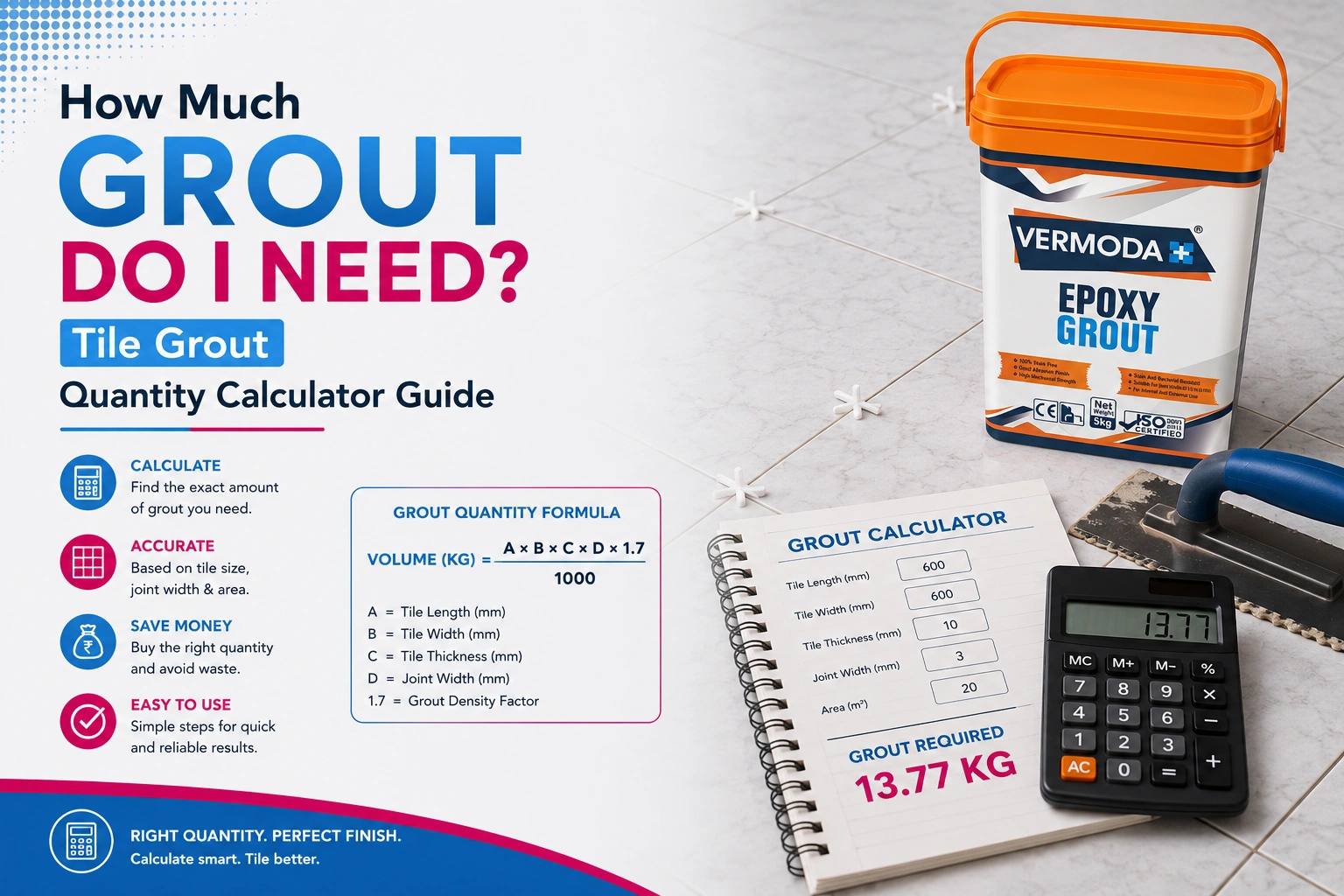
A grout quantity calculator estimates the amount of grout required using tile dimensions, tile thickness, joint width, installation area, and grout density or manufacturer’s coverage data. Larger tiles with narrower joints generally require less grout per square metre than smaller tiles with wider joints. Always add suitable allowance for site wastage.
Grout estimation is important for both small renovations and large construction projects.
Ordering too little can delay installation, while excessive material can increase project waste and cost.
Table of Contents
ToggleWhat Is a Grout Quantity Calculator?
A grout quantity calculator is a method used to estimate grout consumption based on the dimensions and layout of tiled surfaces.
The calculation generally considers:
- Tile length
- Tile width
- Tile thickness
- Joint width
- Total tiled area
- Grout density
- Installation conditions
- Wastage
Manufacturer-provided coverage information should take priority because actual consumption can vary by product.
Why Is Grout Quantity Important?
Correct estimation helps contractors:
- Plan procurement
- Reduce material shortages
- Control project costs
- Reduce wastage
- Schedule installation efficiently
- Maintain consistent grout colour
- Avoid unnecessary emergency purchases
This is particularly important for large residential, commercial, hospitality, and infrastructure projects.
What Factors Affect Grout Consumption?
Tile Size
Smaller tiles create more joints per square metre, increasing grout consumption.
Joint Width
Wider joints require more grout.
Tile Thickness
Deeper joints generally require more material.
Tile Layout
Complex patterns can increase consumption.
Surface Area
Naturally, larger areas require more grout.
Simple Grout Calculation Method
A commonly used planning approach is:
Grout required ≈ joint volume × tiled area × grout density
However, because product density and application efficiency differ, professional estimation should use the manufacturer’s coverage information wherever available.
For accurate project procurement, calculate the theoretical requirement first and then include reasonable installation wastage.
Example: Why Tile Size Matters
Consider two installations covering the same floor area.
| Factor | Installation A | Installation B |
|---|---|---|
| Tile Size | 300 × 300 mm | 600 × 600 mm |
| Joint Width | 3 mm | 3 mm |
| Tiled Area | Same | Same |
| Number of Joints | Higher | Lower |
| Relative Grout Consumption | Higher | Lower |
The larger-format tile generally has fewer joints across the same area, which can reduce grout consumption.
Also Read: What Causes Tile Grout to Change Colour?
How to Calculate Grout Requirement
Step 1: Measure the Area
Calculate the total floor or wall area.
Step 2: Identify Tile Dimensions
Record the exact tile length and width.
Step 3: Check Joint Width
Measure the planned joint width.
Step 4: Confirm Grout Depth
Determine the effective joint depth.
Step 5: Check Manufacturer Coverage
Use the product’s technical information.
Step 6: Add Wastage
Include an appropriate allowance based on installation conditions.
Step 7: Round Up for Procurement
It is generally better to maintain a practical project reserve than risk a shortage during installation.
Cement Grout vs Epoxy Grout Consumption
Different grout systems have different product characteristics, densities, and coverage rates.
Therefore, contractors should not assume that a single consumption figure applies to every grout.
| Factor | Cement-Based Grout | Epoxy Grout |
|---|---|---|
| Composition | Cementitious | Resin-based |
| Coverage | Product dependent | Product dependent |
| Mixing | Usually powder + liquid/water | Multi-component |
| Moisture Resistance | Product dependent | Generally high |
| Stain Resistance | Product dependent | Generally high |
| Estimation Method | Manufacturer coverage | Manufacturer coverage |
For demanding installations, epoxy grout for tiles should be calculated using the specific product’s technical data.
The Role of Tile Adhesive
Grout quantity should be calculated separately from adhesive quantity.
A tile joint grout fills the space between tiles, while tile adhesive bonds the tiles to the substrate.
Using a compatible tile adhesive system is important for achieving stable tile installation.
Common Grout Estimation Mistakes
- Ignoring joint width
- Assuming all grout has the same coverage
- Forgetting tile thickness
- Not accounting for wastage
- Estimating only from floor area
- Using cement grout coverage for epoxy grout
- Ignoring tile layout
- Ordering insufficient material for large projects
What About Grout Admix?
Where a compatible grout admix is specified, the additional liquid component and manufacturer’s mixing instructions should be considered separately.
Never estimate admixture dosage based solely on grout quantity without checking the product instructions.
Cleaning and Grout Consumption
After installation, excess grout should be removed according to the manufacturer’s recommendations.
A compatible tile stain remover may be used later for suitable stains, but aggressive chemicals should not be selected without checking compatibility.
For specific finishing applications, white cement online products may be considered separately from grout quantity calculations.
Expert Recommendation
For project procurement, do not rely on generic online calculators alone.
Use a grout quantity calculator for initial estimation, then verify the result using the actual product’s technical data.
For large projects, prepare a material schedule based on tile size, joint width, application area, product coverage, and expected wastage.
Vermoda Plus
Vermoda Plus offers tile adhesive and epoxy grout solutions for different tile installation requirements.
Its broad product portfolio supports contractors, builders, architects, and project teams seeking coordinated tile installation materials.
Key Takeaways
- Grout consumption depends on tile size, joint width, depth, and area.
- Smaller tiles usually create more joints.
- Wider joints generally require more grout.
- Cement and epoxy grout should be estimated separately.
- Manufacturer coverage data is the best basis for procurement.
- Always account for practical installation wastage.
Frequently Asked Questions
How do I calculate how much grout I need?
Use tile dimensions, joint width, joint depth, total area, grout density, and manufacturer coverage information.
Do larger tiles require less grout?
Generally, larger tiles create fewer joints across the same area and may therefore require less grout.
Does joint width affect grout consumption?
Yes. Wider joints require more grout because they create greater joint volume.
How much extra grout should I buy?
The appropriate allowance depends on tile layout, installer efficiency, joint dimensions, and project conditions.
Is epoxy grout consumption different from cement grout?
Yes. Coverage varies by product formulation, density, joint dimensions, and application.
Can I use a grout quantity calculator for epoxy grout?
Yes, but always verify the calculated result against the specific epoxy grout manufacturer’s coverage data.