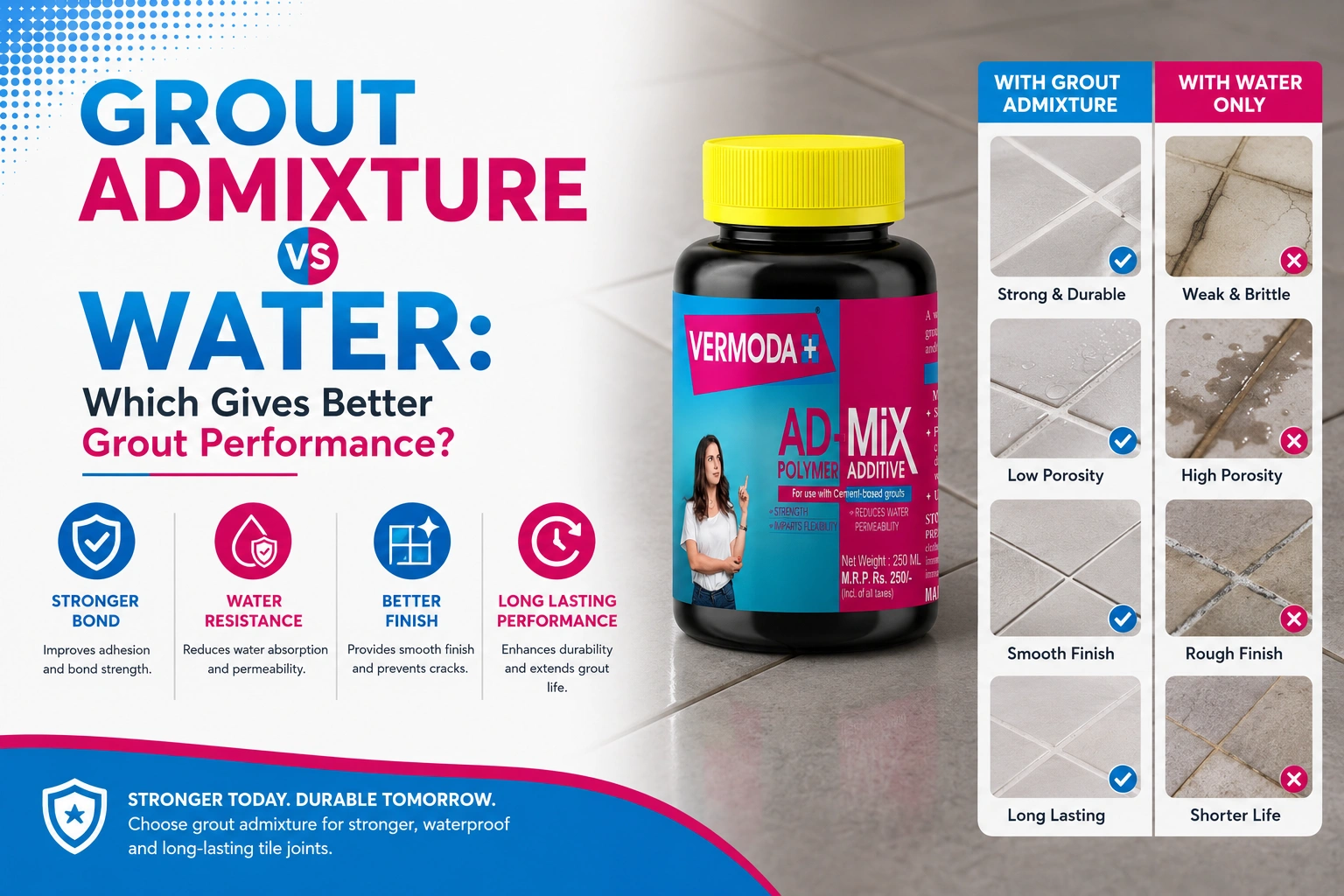
Grout admixture vs water is an important consideration when preparing cement-based grout for demanding applications. Water is commonly used to achieve the required consistency, while a compatible grout admixture can be specified to modify properties such as flexibility, bonding, and resistance. The correct choice depends on the grout product, application, and manufacturer’s instructions.
Using the wrong liquid component or incorrect quantity can affect grout performance.
Therefore, the decision should be based on the complete grout system rather than simply choosing whichever mixing method appears easier.
Table of Contents
ToggleWhat Is Grout Admixture?
A grout admixture is a specially formulated liquid or additive used with compatible grout systems to modify selected performance characteristics.
Depending on the product, an admixture may help improve:
- Flexibility
- Adhesion
- Water resistance
- Crack resistance
- Workability
- Durability
Not every grout requires an admixture, so compatibility must always be confirmed.
Why Does the Mixing Liquid Matter?
The liquid component affects the consistency and performance of cementitious grout.
Using excessive water can alter the mixture and may affect final performance.
Using a compatible grout admix instead can provide specific properties where the product has been designed for that purpose.
The manufacturer’s technical instructions should always determine the correct dosage.
Grout Admixture vs Water: Comparison
| Factor | Water | Compatible Grout Admixture |
|---|---|---|
| Basic Purpose | Mixing | Performance modification |
| Flexibility | Product dependent | May improve flexibility |
| Bonding | Standard | May enhance bonding |
| Water Resistance | Product dependent | May improve resistance |
| Crack Resistance | Product dependent | May improve performance |
| Dosage | Product specified | Strict product dosage |
| Suitable for Every Grout? | No | No |
An admixture is not automatically better for every application. It should be used only where the grout and admixture are designed to work together.
When Can Grout Admixture Be Beneficial?
A compatible admixture may be considered for applications where improved performance is required.
Examples include:
- Areas exposed to moisture
- Certain exterior applications
- Areas subject to movement
- Demanding commercial environments
- Applications requiring enhanced bonding
How to Use Grout Admixture Correctly
Step 1: Identify the Grout
Confirm whether the grout manufacturer permits admixture use.
Step 2: Read the Technical Instructions
Check the recommended dosage.
Step 3: Measure Accurately
Do not estimate the admixture by eye.
Step 4: Mix Correctly
Follow the specified sequence and mixing time.
Step 5: Maintain Consistency
Prepare batches consistently to avoid variations in grout performance and colour.
Step 6: Apply Within Working Time
Follow the product’s application and working-time requirements.
Also Read: How to Choose the Right Tile Joint Filler for Different Tile Sizes?
Can Grout Admixture Prevent Cracking?
A compatible admixture may improve flexibility or other performance characteristics, potentially helping reduce certain cracking risks.
However, grout cracking can also result from:
- Excessive movement
- Incorrect joint design
- Poor substrate conditions
- Incorrect mixing
- Insufficient curing
- Incorrect application
Therefore, admixture alone cannot compensate for an improperly designed or installed tile system.
What About Epoxy Grout?
Epoxy grout for tiles is a different grout technology and generally does not require a conventional cement-grout admixture.
Epoxy grout uses resin-based components formulated to deliver specific performance characteristics.
Role of Tile Adhesive
The grout is only one component of a tile installation.
The adhesive provides the primary bond between the tile and substrate.
For wall installations, the appropriate adhesive wall tiles product should be selected according to tile type, substrate, size, and application conditions.
Common Mistakes
- Adding too much water
- Using an incompatible admixture
- Guessing dosage
- Changing the liquid ratio between batches
- Adding extra water after mixing
- Ignoring manufacturer instructions
- Assuming every grout requires admixture
Where specified, white cement online products should also be used according to their intended application rather than being treated as interchangeable with grout.
Cleaning After Grouting
Once grout has cured appropriately, proper maintenance helps preserve its appearance.
A suitable tile stain remover can be used for compatible stains, but cleaning chemicals should always be checked against the tile and grout manufacturer’s recommendations.
Expert Recommendation
When deciding between grout admixture vs water, do not assume that an admixture is automatically superior.
First identify the grout system, application environment, expected performance, and manufacturer’s recommendations.
If the product is designed for an admixture, accurately following the specified dosage is critical.
Vermoda Plus
Vermoda Plus offers tile installation and grout solutions designed for different project requirements.
Its portfolio supports professional applications across residential, commercial, and infrastructure projects.
Key Takeaways
- Water and grout admixtures serve different purposes.
- A compatible admixture can modify selected grout properties.
- Excess water can negatively affect grout performance.
- Admixture dosage should never be guessed.
- Not every grout requires an admixture.
- Correct substrate, joint design, grout selection, and application remain essential.
Frequently Asked Questions
Is grout admixture better than water?
A compatible grout admixture may improve selected properties, but water may be appropriate where the grout manufacturer specifies it.
Can grout admixture prevent grout cracking?
It may improve flexibility and resistance in compatible systems, but correct installation and joint design remain essential.
Can I add grout admixture to any grout?
No. The grout and admixture must be compatible and approved for combined use.
Can I use extra water with grout admixture?
No. Follow the specified liquid ratio and admixture dosage to maintain the intended formulation.
Does epoxy grout require grout admixture?
Generally, epoxy grout is a separate resin-based system and should be mixed according to its own product instructions.
What happens if too much water is added to grout?
Excess water can alter consistency and may negatively affect the final performance of cementitious grout.